Central Virginia Organic Gardener

"And 'tis my faith that every flower enjoys the air it breathes." - William Wordsworth, 1798

Sunday, November 24, 2013

Gardener's Glossary (an occasional series)

Guttation

     Today's word for your gardener's glossary is guttation.  Guttation is sometimes seen on houseplants or potted plants (at least, that is where I have most often seen it), but can also occur to plants growing outdoors.  Ever see water droplets repeatedly form on leaves, usually at the tip, and drip off?  And I don't mean from rain or overhead watering: guttation occurs when a plant has been overwatered and it is trying to rid itself of excess moisture.  I was drawing a potted voodoo lily this summer and noticed guttation. Sure enough, the plant later collapsed and I discovered that the bulb was rotted, in too-damp soil.  I guess I loved it to death and over-watered it.  
     If you see guttation happening, stop watering the plant, as the soil is likely too wet for that species.  In a potted plant, you may be able to poke a rag or piece of thick yarn into the soil, draping it over the side of the pot, to act as a wick and draw off the water.  Or, place the pot directly on a old towel that has been folded a few times to draw off water.  If the plant is in the ground, stop watering it.  If the guttation is due to lots of rain, cross your fingers and hope for dry weather. If the plant is in a spot that is regularly wet, it might be time to transplant it.
Happy gardening!

Wednesday, November 20, 2013

Wednesday Lagniappe: Wildlife Sighting

An early morning (still dark out) visitor to the last remaining figs on my honey fig tree!

Monday, November 18, 2013

Houseplants: The Unexplored Continent


Houseplants
I have many houseplants, but have not written much about them, with the exception of my citrus trees and banana plants.  Can you care for indoor plants organically?  Yes, and you better!  Any chemical you apply to your plants indoors will stay indoors for quite a while and may volatalize into the air.  In addition, these substances may be absorbed into carpeting and furnishings, only to be re-emitted under certain conditions (increased humidity, for example) or with contact.  Houseplants do have a few problems of their own, and I hope to address this over the next few weeks (molds and fungi, insects, like fungus gnats...).  But plants also have benefits: they are soothing to our psyche, they are beautiful and restful to look at, give us something to care for, and they improve our indoor air quality overall, absorbing some environmental contaminants (from cleaners, paints, etc), as well as taking in CO2 and producing oxygen.

So, I thought I would give a few house plant tips from time to time.  Here is today's tip: did you know that when dust settles on the leaves of your houseplants the dust can block enough sunlight to reduce photosynthesis?  And dust that adheres to the underside of leaves can block the stomata, or respiratory openings, through which the plant exchanges gasses to the air?  Last weekend I took all my houseplants (at least the 40 or so downstairs, haven't done this to to the upstairs plants yet) and did this:
I gave them a lukewarm shower in my kitchen sink. This removed dust, added some moisture and made my plants happy!  At the same time, if you have an over-abundance of mineral salts in soils of salt-sensitive plants (like spider plants, dracaenas: you can tell when you see a white crusty substance on the surface of the soil, and the tips of the leaves often turn brown), you can use this "shower" to flush the salts out of the soil, making sure to let the soil drain well afterwards.
Happy gardening!

Wednesday, November 6, 2013

Extra Wednesday Lagniappe

A one-woman  recycling (community composting) event:

Wonder if I will get any?
Happy gardening!

Wednesday Lagniappe: Fall "Floral" Arrangements

I like to bring in flowers all throughout the growing season, but especially when frost is threatening, as I might not have any more home-grown flowers till spring.  But my idea of a "floral arrangement" is a bit....off.

For example, here are two recent, um, "arrangements" :
This is the Nana dwarf pomegranate, Punica granatum

And here is another oddball:


Brown cotton or Gossypium hirsutum

The second photo was taken by my spouse as part of a series of a reference photos for a drawing of the plant, but then....I decided I kind of like how it looks and have kept it around in my living room. Unfortunately, I do not have a photo of a more "finished" arrangement, but think how cool this might look with some ferns, and a few blooms, around the outer edge!

Happy gardening! 

Sunday, November 3, 2013

Recipe from the Garden: Quick Sauteed Veggies with Italian Seasoning and Cous Cous


Master recipe:

1 cup cous cous
2 cups water
Bring water to a boil, add cous cous, cover and turn off the burner. Ready in 15-20 minutes, reserve for the dish.

A few T olive oil.
1 onion, diced
1 red or yellow bell pepper, diced.
2 cloves garlic, diced or pressed.
1 t each dried marjoram, basil, oregano.
Some sort of greens, chopped, about 1 cup or to your liking: kale, turnip or mustard, chard, spinach.
1 c. broccoli florets
Optional: mushrooms (see special instructions below) and other vegetables, like asparagus chopped, fennel, green beans, zucchini.
Optional: dried tomatoes, sliced olives, feta cheese.

Heat the oil in the pan and saute the onions and pepper with a pinch of salt until golden brown. If you are using mushrooms, I recommend sauteing them to a brown, caramelized stage, separately in another pan in olive oil and a pinch of salt to help them sweat.  Add to sauteed onions when done.  Add the garlic and herbs to the pan. Saute while stirring a few minutes more, add your diced or chopped additional vegetables and cous cous and stir. Cover with a lid and dry steam until the added vegetables are done.  If too dry, add 1 or 2 tablespoons of water or stock before covering. Add in olives, dried tomatoes and feta at the end.  Looks beautiful served on a platter!
Happy eating!


Monday, October 28, 2013

Persimmon and Pomegranate Festival

I went to Edible Landscaping in Afton, VA (http://ediblelandscaping.com/) a plant nursery dedicated to finding, growing and selling plants with edible parts.  Some of these are plants for outside landscaping, some are indoor or greenhouse plants (or need overwintering), and some are for dreamers (they will produce a little, but are great conversation starters!).  I have written about this nursery before, and I am enamoured of its organic practices and mission.  This last weekend (Oct. 26, 2013), the nursery held a "Pomegranate and Persimmon" festival, which included tours of these (and many other) plants.  My favorite plant sold at Edible is the Ichi Ki Kei Jiro persimmon (fondly called "Itchy" at the nursery. Search persimmon entries on this blog for more informatiom). This seemed to be a big favorite during the festival, and were all sold out!  Here are some images with captions and my new acquisitions!

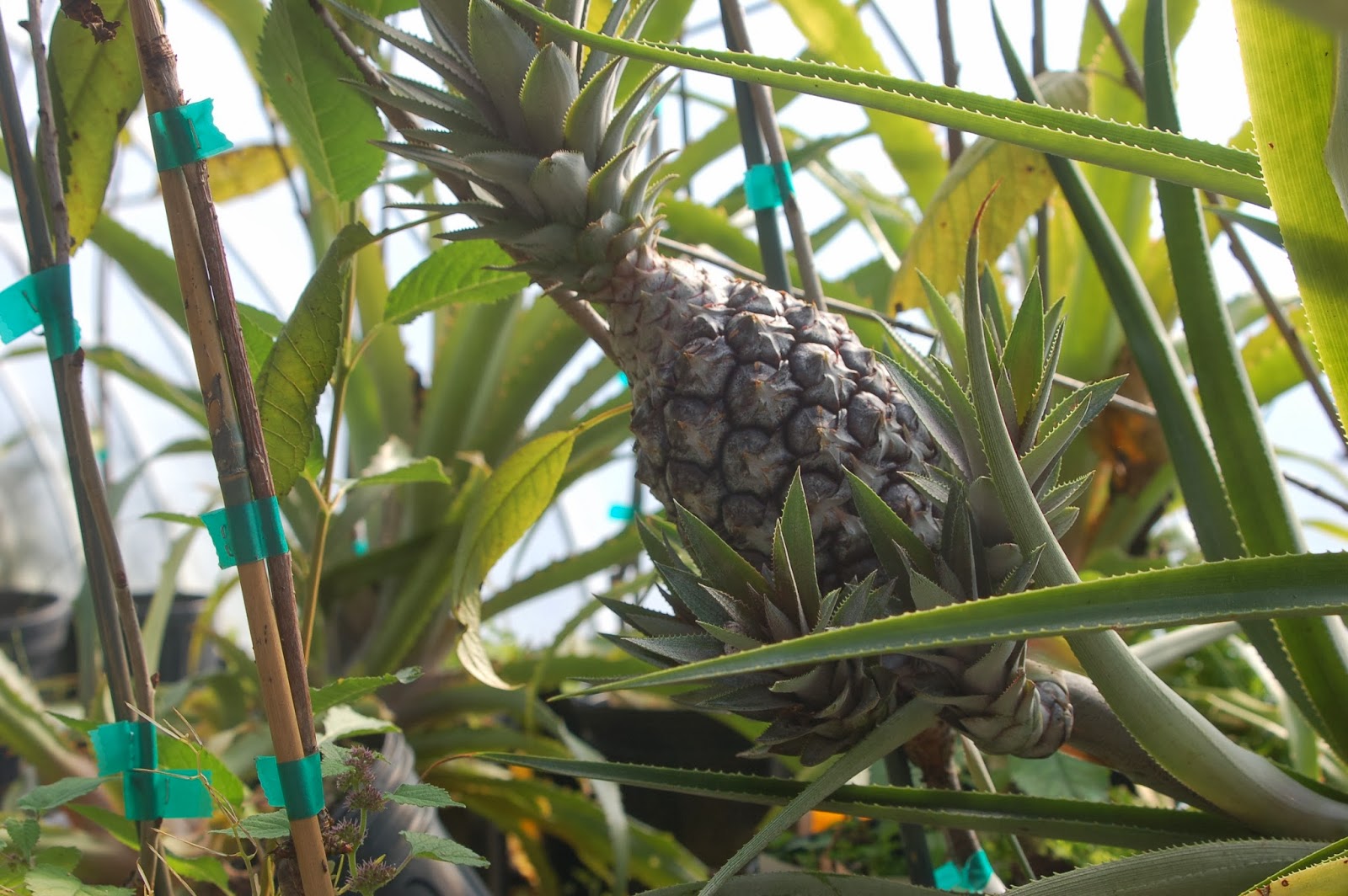
I did not purchase the plant in the photo below, but I will one day soon: a pineapple plant (Ananas comosas).  This is a bromeliad and the main plant dies after fruiting, but see the sprouts below the pineapple in the top photo? These are new plants that can be potted up to start it all over again!


This is an edible cactus: both the fruits and the large paddles are edible (with care taken to avoid and remove the spines!).  The paddles are the basis of dish nopales in Latin American cooking) (Opuntia tuna, the native Prickly Pear cactus):

This is the Hachyia Asian persimmons (Diospyros kaki), a persimmon that must be eaten soft. Gorgeous!  It can stay on the tree and take some frost.
Unfortunately, what I thought was a fully charged camera was not, so I so not have more photos of the festival to show you (search this blog for Edible Landscaping for more photos).  But....

...below here are my two new friends, the taller is a coffee plant (Coffee arabica) and, yes, if I am lucky and diligent, I can make a cup of coffee from it...eventually!  The shorter plant is a Owari Satsuma Mandarin (similar to a tangerine) (Citrus reticulata).  I am able to get fruit from my other citrus, so am hopeful about this one!  Both are waiting to be repotted and placed under lights in my attic.
Go online and look for these fun and unusual festivals in your region!
Happy gardening!