Central Virginia Organic Gardener

"And 'tis my faith that every flower enjoys the air it breathes." - William Wordsworth, 1798

Wednesday, November 6, 2013

Wednesday Lagniappe: Fall "Floral" Arrangements

I like to bring in flowers all throughout the growing season, but especially when frost is threatening, as I might not have any more home-grown flowers till spring.  But my idea of a "floral arrangement" is a bit....off.

For example, here are two recent, um, "arrangements" :
This is the Nana dwarf pomegranate, Punica granatum

And here is another oddball:


Brown cotton or Gossypium hirsutum

The second photo was taken by my spouse as part of a series of a reference photos for a drawing of the plant, but then....I decided I kind of like how it looks and have kept it around in my living room. Unfortunately, I do not have a photo of a more "finished" arrangement, but think how cool this might look with some ferns, and a few blooms, around the outer edge!

Happy gardening! 

Sunday, November 3, 2013

Recipe from the Garden: Quick Sauteed Veggies with Italian Seasoning and Cous Cous


Master recipe:

1 cup cous cous
2 cups water
Bring water to a boil, add cous cous, cover and turn off the burner. Ready in 15-20 minutes, reserve for the dish.

A few T olive oil.
1 onion, diced
1 red or yellow bell pepper, diced.
2 cloves garlic, diced or pressed.
1 t each dried marjoram, basil, oregano.
Some sort of greens, chopped, about 1 cup or to your liking: kale, turnip or mustard, chard, spinach.
1 c. broccoli florets
Optional: mushrooms (see special instructions below) and other vegetables, like asparagus chopped, fennel, green beans, zucchini.
Optional: dried tomatoes, sliced olives, feta cheese.

Heat the oil in the pan and saute the onions and pepper with a pinch of salt until golden brown. If you are using mushrooms, I recommend sauteing them to a brown, caramelized stage, separately in another pan in olive oil and a pinch of salt to help them sweat.  Add to sauteed onions when done.  Add the garlic and herbs to the pan. Saute while stirring a few minutes more, add your diced or chopped additional vegetables and cous cous and stir. Cover with a lid and dry steam until the added vegetables are done.  If too dry, add 1 or 2 tablespoons of water or stock before covering. Add in olives, dried tomatoes and feta at the end.  Looks beautiful served on a platter!
Happy eating!


Monday, October 28, 2013

Persimmon and Pomegranate Festival

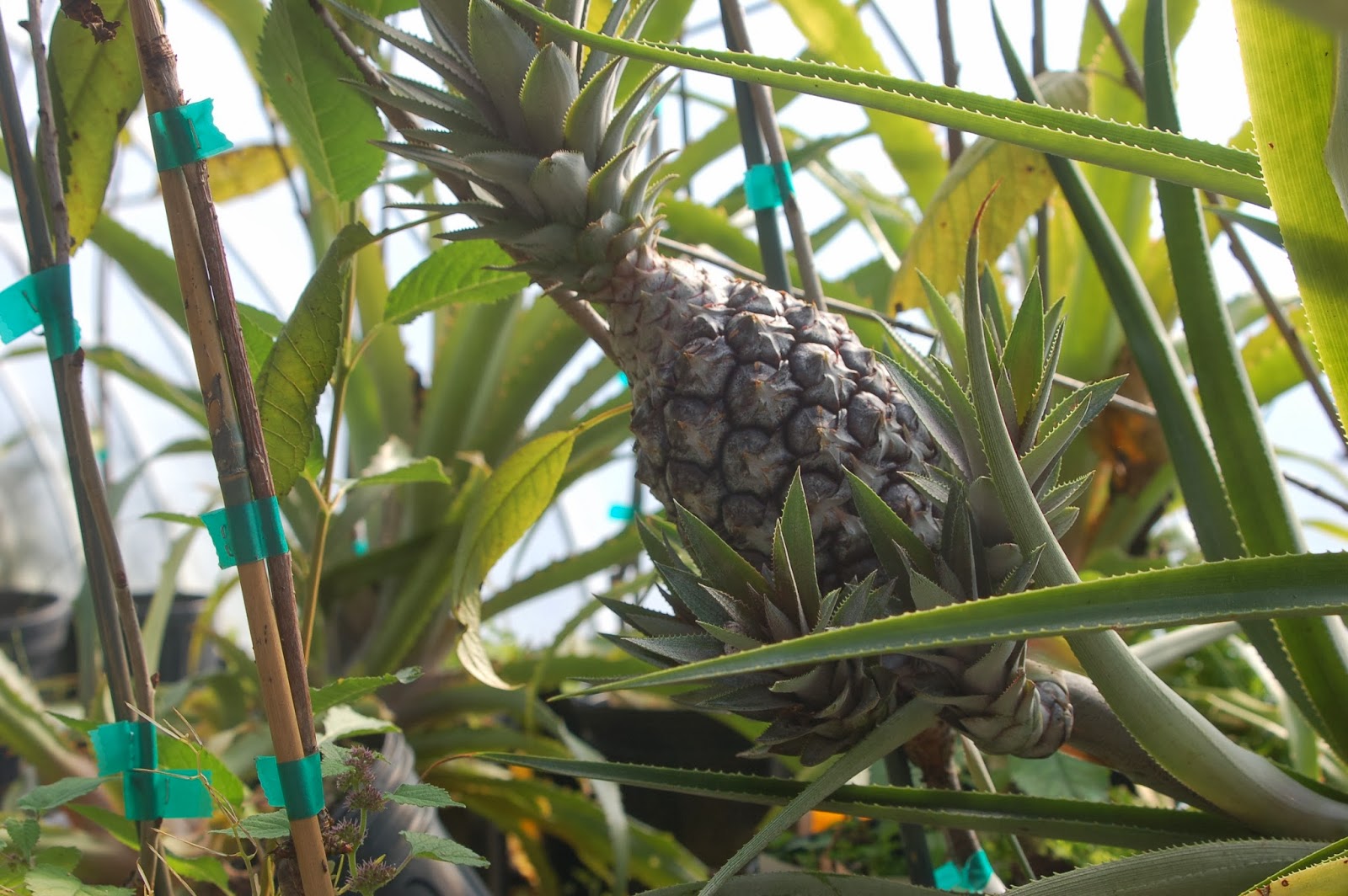
I went to Edible Landscaping in Afton, VA (http://ediblelandscaping.com/) a plant nursery dedicated to finding, growing and selling plants with edible parts.  Some of these are plants for outside landscaping, some are indoor or greenhouse plants (or need overwintering), and some are for dreamers (they will produce a little, but are great conversation starters!).  I have written about this nursery before, and I am enamoured of its organic practices and mission.  This last weekend (Oct. 26, 2013), the nursery held a "Pomegranate and Persimmon" festival, which included tours of these (and many other) plants.  My favorite plant sold at Edible is the Ichi Ki Kei Jiro persimmon (fondly called "Itchy" at the nursery. Search persimmon entries on this blog for more informatiom). This seemed to be a big favorite during the festival, and were all sold out!  Here are some images with captions and my new acquisitions!

I did not purchase the plant in the photo below, but I will one day soon: a pineapple plant (Ananas comosas).  This is a bromeliad and the main plant dies after fruiting, but see the sprouts below the pineapple in the top photo? These are new plants that can be potted up to start it all over again!


This is an edible cactus: both the fruits and the large paddles are edible (with care taken to avoid and remove the spines!).  The paddles are the basis of dish nopales in Latin American cooking) (Opuntia tuna, the native Prickly Pear cactus):

This is the Hachyia Asian persimmons (Diospyros kaki), a persimmon that must be eaten soft. Gorgeous!  It can stay on the tree and take some frost.
Unfortunately, what I thought was a fully charged camera was not, so I so not have more photos of the festival to show you (search this blog for Edible Landscaping for more photos).  But....

...below here are my two new friends, the taller is a coffee plant (Coffee arabica) and, yes, if I am lucky and diligent, I can make a cup of coffee from it...eventually!  The shorter plant is a Owari Satsuma Mandarin (similar to a tangerine) (Citrus reticulata).  I am able to get fruit from my other citrus, so am hopeful about this one!  Both are waiting to be repotted and placed under lights in my attic.
Go online and look for these fun and unusual festivals in your region!
Happy gardening!

Wednesday, October 16, 2013

Wednesday Lagniappe: Persimmon Harvest

My Ichi Ki Kei Jiro persimmons are ripening up!  Here is a photo of the tree.  As I think you can tell, this is a dwarf tree.  And, as you can also see, at least in part, it is loaded with fruit!  Much of the fruit, now turning bright orange, is hidden under the leaves.

To give a sense of the relative size of the fruit, here is is:  it is at least as big as a Big Boy tomato. Delicious too!  This is a non-astringent persimmon, eaten while still crunchy. I have been eating one a day for a about 2 weeks and intend to dehydrate some (yum!)

Happy gardening!

Wednesday Lagniappe: A Bowl Full of Sweetness


Can't you just taste them?  (A few more blemishes than usual, I blame the rainy summer, but oh, so tasty!)  I am going to dehydrate these in slices (no seeds in these babies). You need firm fruit to dehydrate, and these non-astringent persimmons are sweet while still firm.  To dehydrate Asian persimmons, slice in 1/4 to 1/2 inch thick slices and place on a dehydrator at 120-130 degrees.  To peel or not to peel is up to you. I love dried persimmons! (For more info on growing Asian persimmons, search this blog for "persimmons").
Happy gardening!

Sunday, October 13, 2013

Field Trip: The Phipps Conservatory in Pittsburgh, PA

The Phipps Conservatory


A visit to a conservatory or botanical garden is not complete without a camera (though one should not let the camera interfere with the experience of just being there, but that is another story).  I was recently in Pittsburgh, PA and had the opportunity to visit the Phipps Conservatory.  The original glass house of the Phipps was built in 1893, and the new, LEED-certified expansion added over several years and completed in 2006. When they were planning their expansion, the Phipps went as "green" as they could ("green" as in environmentally friendly, not just in adding more plants!), with sustainable building methods and management practices. For example, the Phipps staff seek the least toxic alternative to dealing with pests and disease, incorporating beneficial insects as part of integrated pest management.  They also use mechanical removal (I call is picking and squashing) to remove pests. Even the lawn outside the conservatory is low maintenance: it is infected with a fungus that causes the roots to grow deeply (resulting in a need for less water) and the blades to grow shorter (meaning less frequent mowing).  The new construction is designed to minimize inputs and minimize energy loss to the outside.  In another example, you might see these beneficial insect feeling stations aroud the conservatory:


But the Phipps is also beautiful, strange and exotic, from the bizarre Buddha's hand (Citrus medica var. sarcodactylis):


To the Bat Wing plant (Taca integrifolia):

The conservatory has several rooms, complete with lovely art glass pieces by many artisans:


Doorways into exotic places:
And charming surprises, like a sedum "tree":


Of course there are exotic orchids (some orchid plants were quite large!):


And water gardens (with more glass sculptures):


And Pittsburgh itself is full of art, from the Warhol Museum, to the Carnegie Museum of Art.  I will leave with one Pittsburgh community art project, "Locks of Love!"

The Phipps combines the old and new, with the original 1896 glass houses and the 2006 "Green" conservatory.  If you are in the area, it is well worth the visit!  Oh, the cafe, whihc uses locally-sources, mostly organic ingredients, is pretty good too!

Happy garden visiting!

Monday, October 7, 2013

Typical October Harvest in VA


Oh, yes, a typical October harvest here in central Virginia.  A few remaining string beans, tomatoes, eggplant, muscadine grapes, Asian persimmons and Key limes.  Key limes?  As in the Florida Keys? Yep.  I have written about growing citrus before, so this is sort of an update.   I enjoy growing plants that are atypical for my region (the Asian persommon is another exmaple, though I have seen a few of these trees around the area recently).  Citrus are not very difficult to grow if you have indoor room (like my heated attic) and some shop lights suspended a few inches above the plants (as I do). I grow:

 Key lime, 
Kaffir lime (grown for its pungent leaves used in Thai cooking) 
and a Meyer lemon (not pictured).

So, do I get much fruit?  This is the ultimate gardeners' bottom line. The Key lime seems to be the most productive of the bunch, but I get all the Kaffir lime leaves I need and some Meyer lemons. How much? Enough for a little fresh eating and to make about three Key lime pies per year.  If I had a greenhouse, I would get much more.

How difficult is it to care for citrus in a non-citrus growing zone (we are zone 7, most citrus is grown in zone 9 and 10)?  I set them outside when the days have warmed reliably, in mid-May.  I water and fertilize them with liquid seaweed and fish emulsion, and sometimes a citrus tab (I know, not organic) and recently I had to  bury a rusty nail in the soil for iron (the leaves were yellowing a bit, a sign of iron deficiency).  The only pests I have had are spider mites, which respond to the blast of a hose and a little insecticidal soap, and fungus gnats (many houseplants get these), which I control with a BT granule solution that kills them (BT is a naturally occurring bacteria that is safe to use, unless you are a target insect).  When the trees bloom in winter (filling my house with a lovely scent) I hand pollinate them with a paintbrush.  I (read my strong son) bring(s) them inside around mid-October (definately before the first frost) after blasting them with the hose and spraying with insecticidal soap (if needed).  I occasionally prune them to keep them from getting too tall.  It might be time to re-pot them next spring and I will use a good quality, organic potting soil amended with finished compost!

Happy gardening!  (Spell check is not working, sorry!)