Central Virginia Organic Gardener

"And 'tis my faith that every flower enjoys the air it breathes." - William Wordsworth, 1798

Tuesday, May 11, 2010

SNP Wildflower Weekend


This is probably a ridiculous over-generalization, but I am fond of ridiculous over-generalizations. There are two kind of people I find I really enjoy- librarians and park rangers. Both are very helpful and are probably selected for their knowledge and their people skills. Librarians have helped me develop a love of reading and have gotten me through college, grad school and several personal projects. The park rangers I have met have always been enthusiastic, friendly and helpful.

This past weekend we spent a day (May 8, 2010) at Shenandoah National Park, mostly on Skyline Drive attending one day of their Wildflower Weekend. It was, surprisingly, a sparsely attend event (maybe that was due to the early morning black clouds and the high winds…oh, and it was pretty chilly, compared to my piedmont home). There were several hikes and events to chose from, and I went on an easy hike on the AT called “Cultural Connections” where two park rangers shared what they knew about various native and naturalized plants and their traditional uses. Though I knew a lot already about some of the plants, it was fun to be introduced to plants I had only read about and with which I was unfamiliar. And fun to be with like-minded people interested in plants.

So, here are some of them: yellow mustard or rocket, a relative of arugula (I saw the early leaves a month ago and thought it was arugula):


rag wort, a pretty yellow or yellow-orange flower on a spike:

cranesbill, or wild geranium:

a lovely, leafy false hellebore (looks more like a giant Solomon’s seal to me):

and one of my favorites, the may apple or may pop (the flower and later fruit hides under a large, umbrella-like leaf):

And here is a nasty naturalized plant, garlic mustard. Garlic mustard was brought over by Colonists and was used as a mustard substitute, in “sallets” and as a pot herb. Unfortunately, it is invasive and allelopathic (produces a chemical that inhibits growth of all other plants nearby, as do other plants like walnuts). SNP has 'save the meadow days' in which volunteers are needed to hand pull garlic mustard (and they can give you garlic mustard pesto recipes!).


Another sad botanical sight was this exotic, invasive Japanese grass that is choking areas of woodland and must be dealt with.

During one of the hikes I overheard one ranger mention that there might be some yellow lady’s slipper orchids at a certain mile marker. On the way out of the park, we stopped and parked near that mile marker and carefully trudged through the woods. My husband must have had his “wildflowers eyes” on, because he spotted it well before I did and found a second. This endangered, federally- and state-protected plant is beautiful and I had only seen the pink versions before. Please, if you see one, make sure you tread carefully to not crush small ones and never pick it or dig it up (there is a significant fine). Just enjoy looking at it, take pictures or draw it! If you picked the flower, it would not last long and, if you dug the plant, it would most likely die- orchids need highly specific conditions to grow. Let it grow and perhaps reproduce in its best environment- where you found it.


I did a second activity, a journaling workshop. An earlier session had a number of people, but I and another woman had the ranger to ourselves. He was friendly and did some fun basic exercises in observing an environment and individual flowers and drawing them. No skills necessary. Simple drawings are a way to enhance your journal and your memories of travel of other events. So look for this event next May, though you can take a meadow walk at Big Meadows at SNP all through the spring and summer and learn a lot about the connections between plants and animals.

Happy gardening! And wildflower watching! Check for ticks!

Sunday, May 9, 2010

...and the winner is....


This season I tried two methods of starting sweet potato slips, suspending whole sweet potatoes in water versus planting a sweet potato in a flat on a heat mat. The winner is...the flat method! As you can see above, this is the current state of growth using that method, versus one tiny slip from the ones in water (no pix of those because I planted them in pots to get them to do something!) So, in future seasons I will use this method or some of the other "in soil" methods suggests by readers.
Also, see how nice your lettuce can be in you properly space the plants? (Dope slap to self). For years, I broadcast seed in a bed and got lots of lovely baby greens, but wanted to get some larger heads, so I transplanted stragglers into rows and had great success!
Happy gardening!

Saturday, May 8, 2010

time to thin fruit trees

Time to thin fruit trees


Listen to my pod cast for Friday, May 7th on thinning of fruit on fruit trees (I try not to duplicate topics on blog and pod cast, but this time I had pictures).
To recap: to prevent:
1. too many, small fruits (all that later processing for less gain) and
2. cracking and snapping branches from too much weight from ripening fruit,
you need to thin off immature fruit to about one fruit for 6 to 8 inches of branch. I know it is hard to do, but do it you must! Above and below are some befores and afters (not great pix, but you get the idea. BTW the white stuff on the trees is Surround, an organic, kayolin clay spray that deters most pests on fruits)....
Happy gardening!


Friday, May 7, 2010

Rethinking mahonia? Maybeeee


I recently posted a blog entry about "just not getting it" in regard to some plants or practices and complained I never saw a mahonia (Oregon grape) I liked and that many specimens look scraggly and have sharp leaves. Well, today at Norfolk Botanical garden was one that was...well, OK, I will grudgingly admit- photo above.
Happy gardening!

Thursday, May 6, 2010

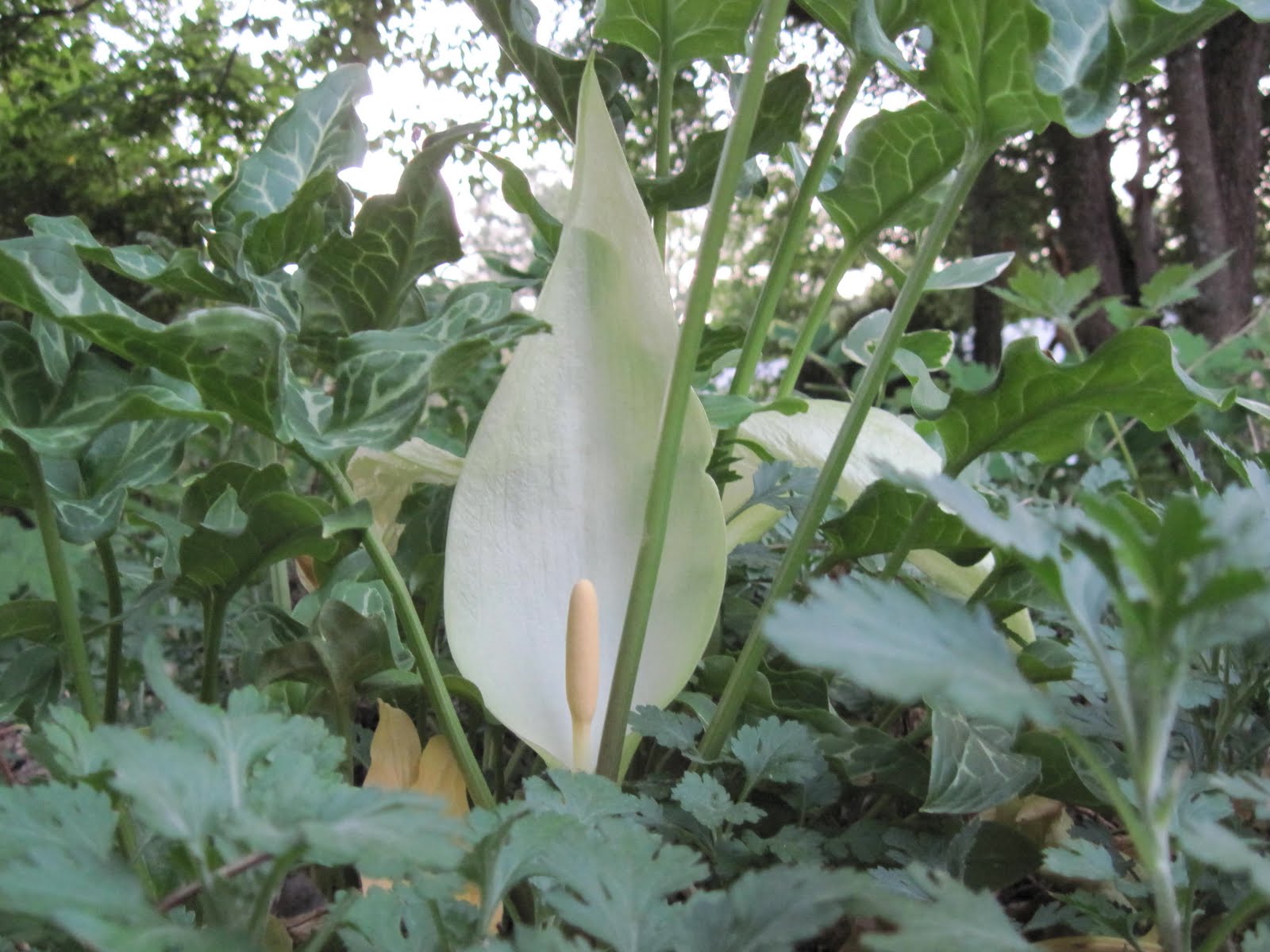
A Lagniappe: Arum italica


A delicate, spathed, fleeting (ephemeral) blossom, Arum italica is lovely- it blooms in April/May here in zone 7, has neat, heavily veined leaves and produces a cool green to red berry spike in fall!

Wednesday, May 5, 2010

High School Plant Sales


It is early May in central VA, so must be time for area school plant sales! For those near Richmond, VA, the Atlee High School (Mechanicsville) 2010 spring plant sale is today through Saturday (photo above), and the Hanover High School spring plant sale starts tomorrow, May 6 through Saturday. Good plants, good prices, good causes! If you live too far away from here to travel, check out your local school web sites for similar sales from their horticulture programs!
Happy gardening!

Sunday, May 2, 2010

Soup Trifecta


I recently posted two soup recipes, inspired by garden produce (sorrel soup and carrots 'n peas soup), so here is the last in this spring soup trio (a recipe I whipped up! Very yummy). It is great with freshly harvested, home-grown asparagus, but you can use farmers' market or store bought:

Creamy Asparagus soup
2 T butter, divided
1 large onion, diced
1 cup sliced mushrooms (I like Baby Bella)
salt and freshly-ground black pepper, to taste
1 t dried marjoram
2 white potatoes, peeled, sliced thin
About 1 bunch asparagus, washed, chopped into 1 inch pieces
1 quart stock (I used homemade vegetable stock, but can use chicken).
1/2 c. sour cream (low or non-fat OK, can substitute yogurt or buttermilk in a pinch)
1 t grated lemon zest

Melt 1 T butter in a sauce pan, the other T of butter in a Dutch oven or stock pot. Saute and caramelize the onions in one, mushrooms in another (crowding one pan with both will cause the vegetables to steam or stew and not caramelize, and you will not get their full flavor) sprinkling both with salt to sweat them a bit. When the onions are light brown and sweet tasting (20 minutes on low to medium heat) and the mushrooms are browned and soft (same) you can put them in the Dutch oven. Add the black pepper to taste and marjoram and cook on medium for 5 minutes. Add the potatoes, asparagus and stock and simmer for 30 minutes, lid on, until the potatoes and asparagus are soft. Take off heat, let cool and puree in blender or food processor (to speed this up, I use a large slotted spoon to remove the solids, cool them on a plate, the puree those, leaving the hot liquid in the Dutch oven).

Return puree to pot and warm it up if it has cooled a lot. When warm enough to eat, add sour cream and lemon zest. Serve with a salad from your garden and some home made bread, if you have it (I made pita bread).

Happy eating, one of the great pleasures of happy gardening!