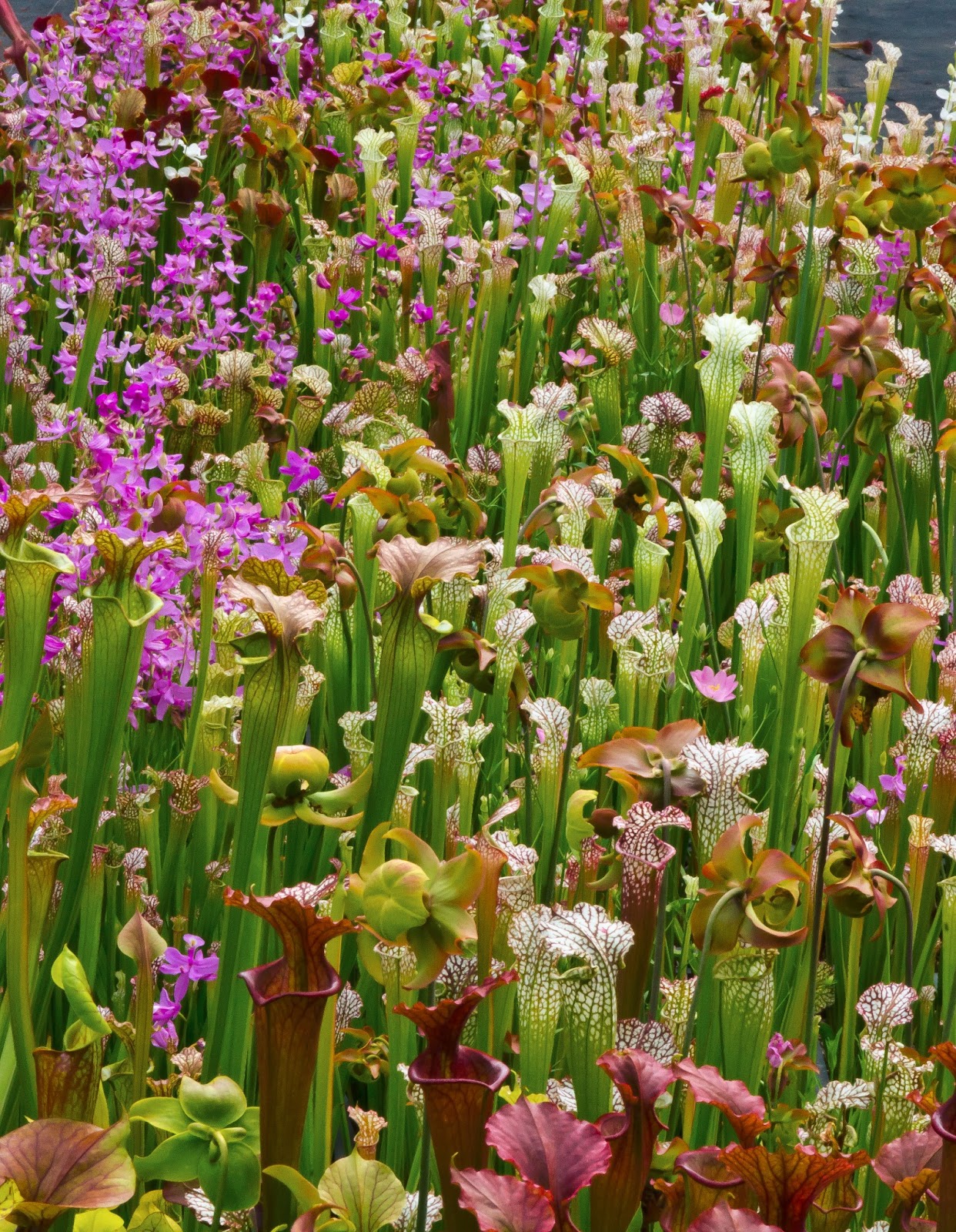
Wonder what the plant "pitchered" above is? It is a Sarracenia, or pitcher plant. This species is native to North America and I have been lusting after it for years. So, why haven't I grown one before? Though not hugely difficult, pitcher plants require highly specialized circumstances in which to grow. These plants thrive in sun-drenched bogs with low pH and NO nitrogen. In fact, the easiest way to kill this plant is to give it fertilizer! Let me explain...
Pitcher plants evolved in acidic, low nutrient, boggy situations. Unlike a pond, a bog is not always filled with water, but it is always moist. So, it needs some drainage, but not a lot. All plants need nitrogen and the pitcher plant is no exception, but acidic bogs have little to no nitrogen. So, like Venus flytraps (also native to the US) the pitcher plant is carnivorous. No, it does not have a hinged, mouth-like trap that snaps. Instead, after the plant flowers (the photo above is of its flower bud- and a very exotic looking flower it is: go to
http://en.wikipedia.org/wiki/File:Sarracenia_alata_flowers.jpg for some photos)
-it sends up a hollow tube, filled with a digestive enzyme and downward pointing hairs. Bugs, attracted by some nectar, fly into the tube, but cannot get out: those downward hairs act like lances to them. So, they drop down further and further into the pitcher, seeking a way out. Finally exhausted, the bugs fall into the enzyme and are slowly consumed by the plant, becoming its main source of nitrogen.
Building the bog bed was not difficult, First, clear an area, making it level. Line it with small opening garden cloth (wire fencing) to keep voles out. Then, build your sides- I used landscaping rock. You need to measure the area for a butyl pond liner, or you can use 4-6 ml plastic sheeting, enough to overlap the top of he wall. Poke holes every foot or so in the base of the liner (you need some drainage) and line the bottom with sand. Then add a 1:3 mix of sand an peat moss, both wetted (it can take a while to get peat moss wet, so do not plant immediately). I then placed a soaker hose over the top (and I did bury one in the bed itself, with the end above the bed, incorporated into the wall for later watering) and set to drip for 8 hours or overnight. When the peat is thoroughly wetted (dig a little and you will see if it is), you are set to plant! First, adjust the edges of the liner, covering them with whatever material you used to make the bog walls.
I bought my plants from a nursery in Stanardsville, VA that specializes in carnivorous plants and does some retail business:
Retail orders must be $100 at least, but this is not hard to do! I planted two varieties, S. flava and S. leucophylla. Watch this space for future updates and photos!
If you don't want to plant your own or don't have the room, Lewis Ginter Botanical Garden has some great varieties, in bloom today (May 5) for the next few weeks! At:
http://www.lewisginter.org/
Happy gardening!