Central Virginia Organic Gardener

"And 'tis my faith that every flower enjoys the air it breathes." - William Wordsworth, 1798

Showing posts with label tomato. Show all posts

Wednesday, August 5, 2020

Something's Rotten...

See the sad, little tomato above?  This little guy has blossom-end rot (let's call it BER).  If you've had it (and you likely have) you know that this tomato will never properly ripen, nor will it be edible. Every year, I plant a blossom-end rot resistant variety (Parks Whopper Improved).  When I plant, I put the tomatoes deep into the soil or trench them, and place a calcium source (half a 1000 mg. calcium supplement, a calcium-based antacid, or finely-ground eggshells) in the hole with the plant. I thought that was it, that the plants were now protected from this problem, after all, BER is caused by a calcium deficiency.  That's true, but all the calcium in the world won't prevent BER if you have inadequate, irregular watering.  Too little water interferes with the plants ability to transport calcium into the tissues of the plant (and, as you may know, an over-abundance of water can cause fruit to split).  So this is a two-tiered problem, caused by calcium deficiency and inadequate watering.  (Having a resistant variety is good, too, as is a 4-year crop rotation).  By the way, peppers (especially bell) can also suffer from BER.
I will write more one day about the other reason I grow Whopper Improved...and other highly-disease resistant plants.

Tuesday, December 16, 2014

Tomato Musings

 
It is getting near Christmas, and I am listening to holiday music. We have four, measly, poorly-ripened tomatoes left from the garden that likely won't taste very good.  The season of craving that homegrown, sun-ripened tomato has arrived.


You know how how people in a state or area with decent tomato-growing conditions say their tomatoes are the best?  In Virginia, many counties claim their 'maters have no equal, are the ultimate in tomato-ness, including Hanover, where I live.  And I grew up in New Jersey where the same claims are made.


Why is this?  I have a theory.  When you bite into that perfect homegrown tomato in July, to what are you comparing it?  Perhaps you are comparing it to those nasty, styrofoam-like, tasteless red orbs purported to be tomatoes that are sold in the grocery store year round.  Those things are often grown in Florida (terrible conditions for tomato growing), picked green and artificially ripened in a warehouse flooded with ethylene gas.   Gross!  They taste nothing like a good tomato...or even like a marginal homegrown one.  So, any homegrown tomato that is ripe, and has never been refrigerated, is infinitely superior, whether it comes from Jersey, Virginia, Delaware or North Carolina...or any zone good for the solanaceae. Oh, and sometimes when you buy tomatoes at a farm stand, they have been refrigerated or chilled.  Nothing ruins their flavor faster.
I just about never buy off-season tomatoes, choosing to add beets, carrots, olives to my salads and sandwiches instead. 
And "I'm dreamin' of a red tomato...just like the ones I used to know..." 
Happy Holidays!

Sunday, August 26, 2012

Heirlooms Break My Heart


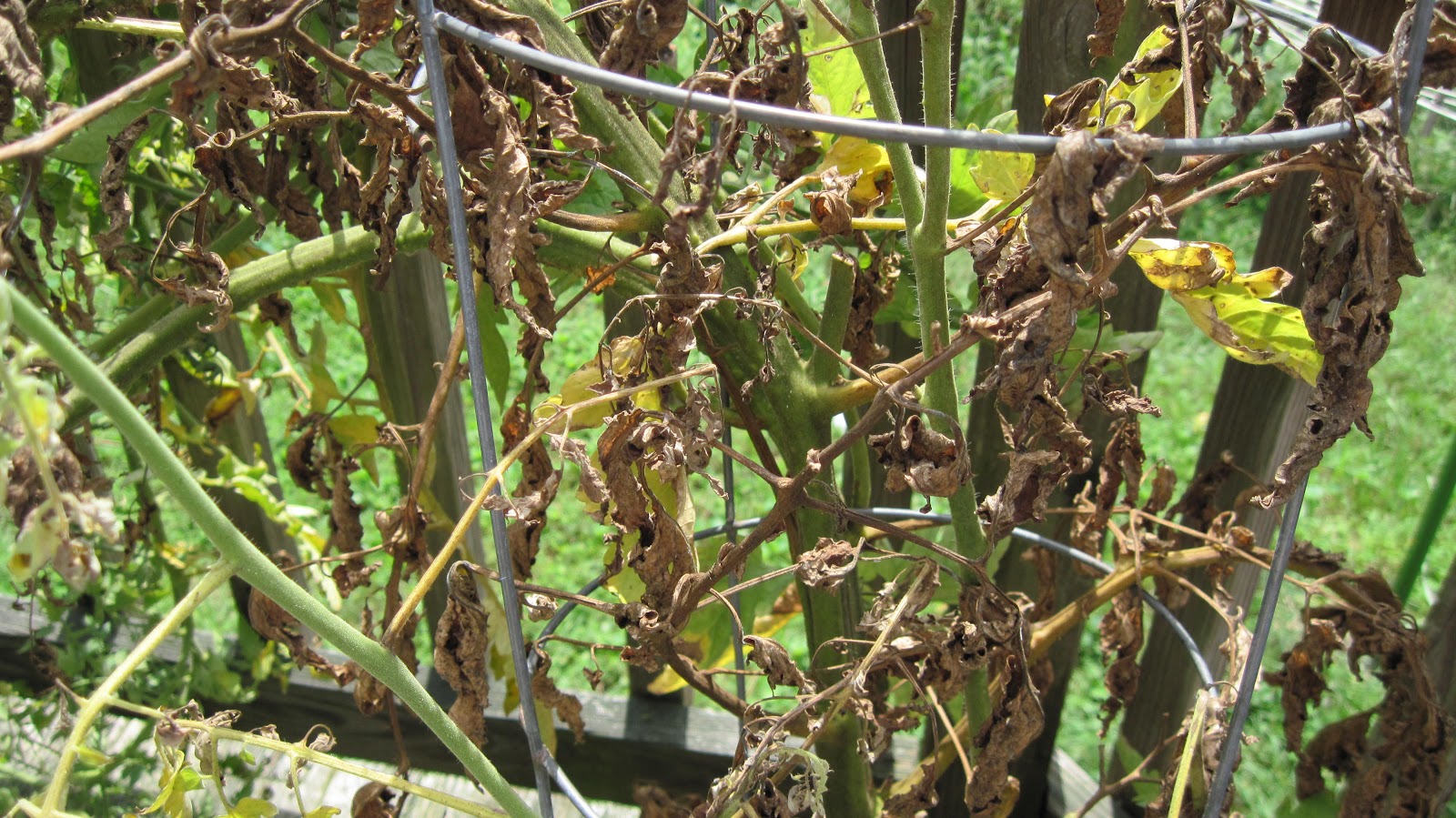
Poor sick tomato. When I started gardening, I grew heirloom varieties, like Brandywine, Mr. Stripey, Mortgage Lifter and the like, but soon switched over to the most disease resistant varieties I could find because of problems with disease.  Well, I was recently seduced by "free" packets of organic, heirloom seeds and a healthy Mr. Stripey plant at a local plant sale (and I really like the taste and color of Mr. Stripey).  Big mistake.  The plants quickly succumbed to disease (which one?  I'm not sure, other than it did not have the symptoms of early blight), while my disease resistant Goliath and Whopper were still producing fruit and looking good- and they were all shoulder to shoulder in the same garden area.  Very disappointing.

How do you know if you have a disease resistant tomato?  Look for letters (like V, F, and T) after the name.  These stand in for the names of the diseases like verticillium wilt, fusarium wilt and tobacco mosaic virus (smokers should wash their hands before touching tomato plants to prevent spread of this last one from cigarettes with infected tobacco to the tomatoes).  Tomato diseases are many and varied and can be hard to diagnose, but two sources can help: your local Ag Extension Agent and the Plant Doctor at; http://vegetablemdonline.ppath.cornell.edu/DiagnosticKeys/TomWlt/TomWiltKey.html

I am not exactly sure what disease affected the heirloom cherry tomato in the photo above.  When I shop for seeds, I look for descriptions like "most disease resistant"  and "highly disease resistant" and a long string of letters after the plant name!  No more free tomato seeds for me unless they are tough disease fighters!

Happy gardening!

Monday, January 26, 2009

2009 Seed Order


2009 Seed Order


(Photo caption: a photo that is totally unrelated to this entry, but is cute!)


I have a tradition I created and have followed for about 15 years, maybe 20. January 1st is the day I sit down with my seed catalogs and make my order for the coming season. Here is a list of what I ordered this year, with some explanation as to why (and a brief primer on tomato types at the end).

From Pinetree Garden Seeds (http://www.superseeds.com/): But first, why I love this catalog. There are no fancy, glossy photos, but this company consistently produces good seed in smaller qualities (and lower prices, though they have gone up over the past 2 years, but what hasn’t?) for the home gardener. Most of the time, the quantities they give me are sufficient for my needs and I don’t pay for a lot of wasted seeds. I do need some seeds in quantity (like carrots) so I just get these elsewhere. They also stock discount and full-price garden books, and garden tools and supplies.

Pencil Pod bean, Dragon Langerie Bean and Marengo Romano pole bean: these three are the yellow beans I prefer
Yard long bean: an experiment for this season. Supposed has a slight asparagus taste
Early Wonder beet: in my continued attempt to grow a decent beet. Seems to get too hot here too fast, so many an early beet??Orange Fantasia and Pink Lipstick Chards: I love greens, chard is my favorite! Except when kale is my favorite!
Sweet Success Cuke
Black Beauty, Lavender Touch and Raveena (green) eggplants: for taste and beauty.
Redibor kale: tasty and pretty, does well here.
Beleah Rose, Matina Sweet, Freckles and Pine tree mix lettuce: remember, I love greens!
Sugar Snap and Cascadia peas: both sugar snap and do pretty well here. I am going to start then early in my cold frame- I get a good flush of peas, then the heat hits…
Kaleidoscope mix pepper- have had good luck with this bell pepper mix
Paprika Pepper: home to convince my neighbor to smoke some for me so I can have home-smoked, dried paprika.
Early Jalapeno
Small Sugar pumpkin: a nice heirloom, tasty
Long Island Cheese winter squash- great for pies. We’ll see who wins this year, the squash vine borers of the pumpkin vine.
Broccoli Di Rapa: Novantina: a broccoli rabe and I hope I can make a go of it! An experiment.
Italian Large Leaf Basil and
Lovage: a great celery substitute, a perennial.

From Totally Tomatoes: I like the variety of this catalog and can always find something interesting. This year, I am ordering all disease-resistant varieties- having some problems with disease, so will not grow heirlooms this year (though they do taste great!):

Better Boy Hybrid Tomato VFNASt Indeterminate
Parks Whopper Improved VFFNT Indeterminate (sturdy and reliable)
Sunmaster Hybrid VFFASt Determinate and
Kada Hybrid VFFASt Indeterminate

[Wonder what those letters after the names mean? They are codes for different diseases to which the plant has demonstrated resistance.
V: Verticillium wilt
F: Fusarium wilt (FF races 1 and 2, FFF races 1,2,3)
N: Nematodes
T: Tobacco Mosaic Virus (if you are a smoker, wash your hands after smoking and before handling tomato plants and don’t smoke in the garden).
A: Alternaria stem canker
St: Stemphylium Gray Leaf Spot
TSWV: Tomato Spotted Wilt Virus ]
(Also Determinate plants are bushy and produce most of the fruit in one or two flushes. Indeterminate plants are vines that grow throughout the season and keep producing fruit until frost. Canners like determinates).

Happy seed starting!