One of my favorite programs, NPR's "Science Friday," recently provided validation of my abhorrence of lawns! Yay! Listen to this illuminating, 11 minute piece at:
http://www.sciencefriday.com/segment/08/16/2013/for-a-greener-yard-lose-the-lawn.html
Happy gardening!
Central Virginia Organic Gardener

Wednesday, August 28, 2013


Sunday, August 25, 2013
Hippy Apples

This year we have what I call "hippy apples." In the 1970's, when some back-to-the-land, counterculture folks (my spiritual ancestors in some ways) began organic gardening and farming, there were fewer organic tools at their disposal to care for fruit trees and carry the fruit through to harvest. There were many a tale of misshapen, wormy, corky, organic apples during this time, aka "hippy apples." Now, I am not claiming to have grown excellent and cosmetically perfect apples in my life, but they have been of better quality than this year. So what happened this year? Rain, rain and more rain. Every time I had the opportunity to spray the trees with Surround (a trademarked, kaolin clay substance that presents a barrier to apples maggots and the like) it was raining or about to rain. You see, kaolin clay is water-soluble and washes off in the rain. A light rain has not too much of an effect, but heavy rain, like we had one and off all during the season that the apples were forming. In addition, wet conditions promote fungal diseases and I could not spray for that either. So, we got the hippy apples pictured above.
So, do we need to trash them? Not at all. These apples still have plenty of tasty, edible flesh and I am pretty darn good at peeling, removing the bad parts and slicing them. Below are the sliced apples, in our dehydrator, ready for lovely dried apples to eat and bake with all winter long. By the way, I pre-soak them for 2 minutes in a solution of 4 cups of water, 600 mg crushed vitamin C pills and 1/4 c of lemon juice to prevent browning in the dehydrator. From yuck to yum!

Happy gardening!
Wednesday, August 7, 2013
Wednesday Lagniappe: Gratuitous Photo

A totally gratuitous photo of the Fluff Monster getting a much-deserved bath! Happy Wednesday!
Sunday, August 4, 2013
Waltham butternut and the dreaded "vacation zucchini"

I have been casting about for a winter squash that is productive, and fights back when squash vine borers attack. I searched for a winter squash that was resistant to squash vine borers and settled for the old-time favorite, Waltham butternut. Apparently, any squash with harder stems is more resistant to these pests, the plague of squash growers everywhere. I planted my butternuts late (apparently a no-no: early planting helps foil these beasties) and they began producing the beautiful fruits you see here. The plants did finally get borers, but I used a garden syringe to inject BT (a bacteria that only kills caterpillars who munch on it) and the plants are still out-growing the borer damage. I also will mound soil over various parts of the stem to encourage it to root, and I think I may get some more squash from these babies (this is from 2 plants).
Also pictured, the gardener's embarassment: vacation zucchini. If you go away during the summer, have a neighbor pick your zucchini! Large ones like these can be shredded and frozen for winter soups and stews. If they have sizeable seeds, core them to remove the seeds before you shred them. If they get woody, it is time for the compost heap!
Happy gardening!
Thursday, August 1, 2013
Wednesday Lagniappe: Food for Thought
An interesting link on the globalization of landscapes....
http://www.huffingtonpost.com/lisa-novick/just-because-itll-grow-in_b_3621351.html
http://www.huffingtonpost.com/lisa-novick/just-because-itll-grow-in_b_3621351.html
Wednesday, July 31, 2013
Wednesday Lagniappe: Big Trees, Little Trees
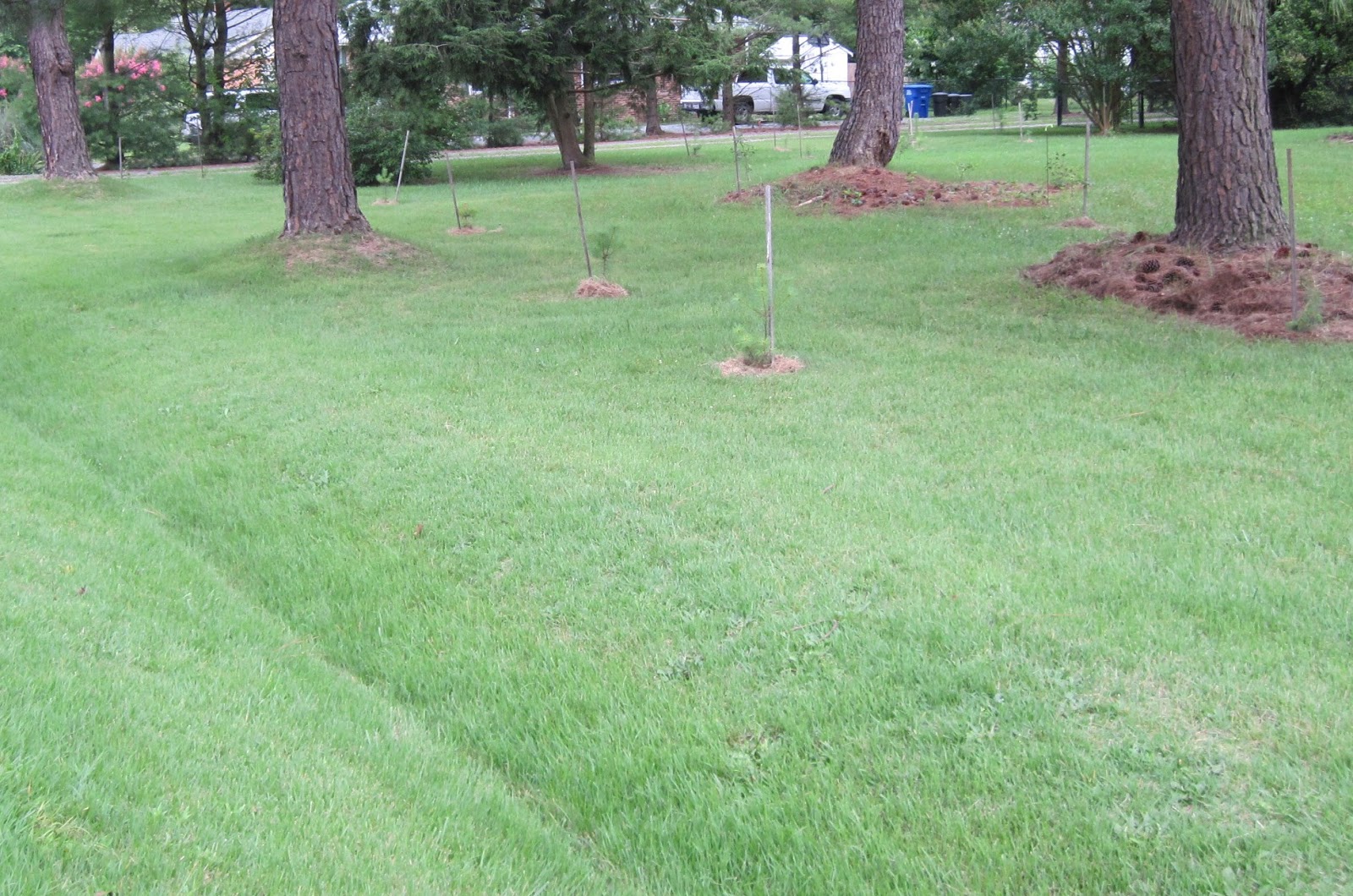
Can you see the see the tiny, newly planted trees in this landscape? These folks have 6, huge, mature, loblolly pines in their yard and just recently planted more than a dozen tree seedlings! As you can see (look for the stakes) some are planted right next to the huge trees (wonder how they managed to avoid the roots) and others nearby. I am skeptical about the placement of these trees- some seem to be species that will grow into very tall trees when mature, and they have no space to do so. In addition, the existing mature trees will suck up all available water and nutrients in the yard (I am surprised the grass looks so good- these folks must water and fertilize frequently) robbing these seedlings of what they need to survive. The prediction for these seedlings is dismal. I will have to check it out over the next few years to see what happens.
The bottom line, that many gardeners (including myself in the past) often violate is to know the mature size of the plant and make sure you have the space for it before you plant! If not, you will crowd out other plants already in the space, the new plant may be malformed and weak, or you it might threaten nearby plants and structures (like the neighbor who planted a row of tiny Leland cypress plants directly under power lines, only to have to chop these fast-growing trees down 5 years later).
Happy gardening!
Sunday, July 28, 2013
Partial Success with Peaches
This was the WORST season to grow peaches organically in Virginia in the 10 years I have been growing them here. We had so much rain, I either could not use the regular organic sprays (they would wash off or it was raining when I was free) and rain encourages the awful molds and rots that affect peaches. I had also decided that this might be the season I would take out all three trees.
A few months ago I posted the first photo below in a blog on bagging my peaches. This labor-intensive method is used for apples in some situations, but not as often for stone fruits. I took regular paper lunch sacks and used a stapler to hold the bags on, after I had gathered in the edges.
My first concern was that the bags would not last for the few months till harvest. Even with all this rain, they lasted just fine (a few fell off due to being put on poorly).

(below is a photo of my typical harvest- they peaches look OK and have enough usable flesh on them, but might have little caterpillars inside).

Did this method work? After a fashion. I probably bagged the peaches too late, after some insects had laid their eggs under the skin and they had been exposed to disease. Some of the bagged peaches did spoil or fell off. But, enough came through looking good that I decided to keep two trees and try again next year. The peach on the left, below, was bagged, the one on the right was not. You can see the bagged peach is imperfect, but it was intact, had no rot and no unwelcome creature inside. I did have to take the bag off when the peach reached full size- it seems that peaches need some sun to fully ripen. But, even though other peaches on the trees were infected with fungal rots, many bagged peaches did just fine.

So, lessons for next year:
1. Spray early with Surround, a kaolin clay mix, and antifungals then
2. bag as many peaches as I can, after thinning. I will probably try this with my apple tree too!
I am also going to be severely pruning the trees (more so than I already have). Peaches need this, and these particular trees are shading too much of my veg garden.
I hope this works. I love peaches, but commercial peaches are in the top 5 of pesticide-residue fruit and have multiple chemicals sprayed on them.
Happy gardening!
Subscribe to:
Posts (Atom)